
RWU UAR
RWU UAR is a compact, curiosity-provoking phrase that shows up across education blogs, tech roundups, and research pages. Depending on context, it functions as an acronym, a conceptual label, or even the name of a program. That ambiguity is part of its appeal: people see RWU UAR and expect something interdisciplinary, international, or cutting-edge. This guide gathers definitions, histories, use cases, implementation steps, and future possibilities so you — the reader, researcher, or practitioner — can understand and act on the idea.
RWU UAR Meaning and Definition
At its broadest, RWU UAR is a multi-interpretive acronym that commonly appears in three overlapping fields:
1. Higher education / undergraduate research contexts — where RWU references specific universities (for example, Roger Williams University) and UAR represents “Undergraduate Academic Research” or “University Applied Research.” This reading treats RWU UAR as a programmatic label for student research initiatives.
2. Conceptual/organizational frameworks — where RWU UAR is used as a symbolic brand for collaborative, research-led units (e.g., “Research World Unit — Universal Action Region” or similar constructs). In these uses, the phrase is deliberately abstract to capture a forward-looking, transdisciplinary identity.
3. Technical / IT meanings — where isolated technical environments interpret RWU UAR as shorthand for operational terms like “Read/Write Units” and “User Access Requests,” connecting it to data handling, security, and systems design.
Because RWU UAR appears in varied contexts, the safest definition is to treat it as a contextual acronym — one whose precise meaning depends on the domain and intent of the author. This flexibility explains both its rapid spread and the occasional confusion around it.
The Origins and Development of RWU UAR
The exact birthplace of RWU UAR remains somewhat mysterious, which only adds to its intrigue. Early mentions surfaced in academic newsletters from mid-sized universities experimenting with undergraduate research models. Around the same time, technology forums began using similar abbreviations to describe workflow automation and access control systems.
What makes the development of RWU UAR particularly interesting is how different communities adopted it independently. Education administrators saw it as a fresh way to brand research opportunities. IT professionals appreciated its brevity when documenting system architectures. Researchers valued its adaptability when describing cross-institutional collaborations.
Over the past decade, RWU UAR has evolved from a niche term into a recognizable shorthand. Its growth mirrors broader trends toward interdisciplinary work, open-access research, and flexible organizational structures. The phrase now appears in conference abstracts, grant proposals, and even social media discussions about innovation in learning and technology.
Why RWU UAR Matters Today
In an era where collaboration crosses traditional boundaries, RWU UAR serves as a useful conceptual bridge. Its importance stems from several contemporary needs:
Interdisciplinary Communication — Academic and professional fields increasingly overlap. A term that can mean different things in different contexts helps people start conversations without getting locked into rigid definitions.
Student Empowerment — When universities use RWU UAR to describe undergraduate research programs, they signal that serious scholarly work isn’t reserved for graduate students or faculty alone. This democratization of research opportunities encourages younger scholars to contribute meaningfully.
Operational Efficiency — In technical settings, RWU UAR provides shorthand for complex processes. Teams can reference read/write operations or user access protocols quickly, streamlining documentation and communication.
Innovation Branding — Organizations looking to position themselves as forward-thinking often adopt flexible terminology. RWU UAR offers that flexibility while maintaining a professional sound.
The relevance of RWU UAR today lies in its ability to adapt. As workplaces become more agile and educational institutions more experimental, concepts that resist narrow categorization become more valuable, not less.
Applications of RWU UAR
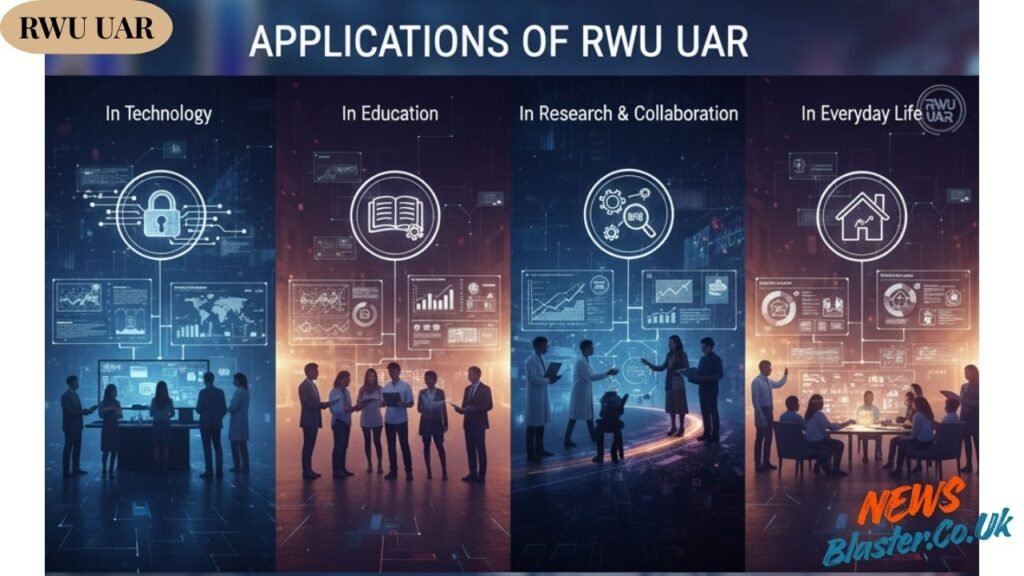
In Technology
Technology teams have found practical uses for RWU UAR in several areas. Systems administrators reference it when designing access control frameworks that balance security with usability. Software development teams use related concepts when building applications that require granular permission settings.
Data management professionals apply RWU UAR principles when establishing protocols for who can read, write, or modify information within databases. This becomes especially important in environments handling sensitive information, where audit trails and permission hierarchies must be clear and enforceable.
Cloud infrastructure planners sometimes use RWU UAR as conceptual shorthand when mapping how different user groups interact with shared resources. The term helps teams visualize complex permission structures without getting bogged down in technical jargon during early planning stages.
In Education
Educational institutions have embraced RWU UAR as a way to brand and organize undergraduate research initiatives. Universities create RWU UAR programs that give students hands-on experience with real research questions, often pairing them with faculty mentors or industry partners.
These programs typically include proposal writing, data collection, analysis, and presentation components. Students learn research methods while contributing to ongoing scholarly conversations. The RWU UAR label helps distinguish these structured opportunities from standard coursework or independent study arrangements.
Some schools use RWU UAR to describe cross-campus collaborations where students from different institutions work together on shared projects. This application emphasizes the “universal” aspect of the acronym, positioning research as a borderless endeavor that benefits from diverse perspectives.
In Research & Collaboration
Beyond individual institutions, RWU UAR appears in descriptions of multi-organizational research networks. These collaborations often involve universities, private companies, and government agencies working toward common goals.
The term provides a neutral label that doesn’t privilege any single partner. When a pharmaceutical company, a state university, and a federal lab collaborate on public health research, calling their partnership an RWU UAR initiative signals equality and shared purpose.
Research consortia use RWU UAR to describe data-sharing agreements, joint grant applications, and co-authored publications. The acronym’s flexibility allows partners to emphasize different aspects depending on their audience — technical precision for grant reviewers, collaborative spirit for public communications.
In Everyday Life
While RWU UAR originated in specialized fields, its principles have everyday applications. Individuals managing personal projects can adopt research-led thinking by treating problems as questions requiring investigation rather than obstacles requiring immediate solutions.
Community organizations apply RWU UAR concepts when they engage residents in participatory research about local issues. Instead of experts studying communities from outside, RWU UAR-inspired approaches make community members co-investigators.
Even family decision-making can benefit from RWU UAR thinking. When choosing schools, planning moves, or making health decisions, families who gather evidence, test assumptions, and remain open to revision often reach better outcomes than those relying solely on intuition or conventional wisdom.
How to Implement RWU UAR in Real Life
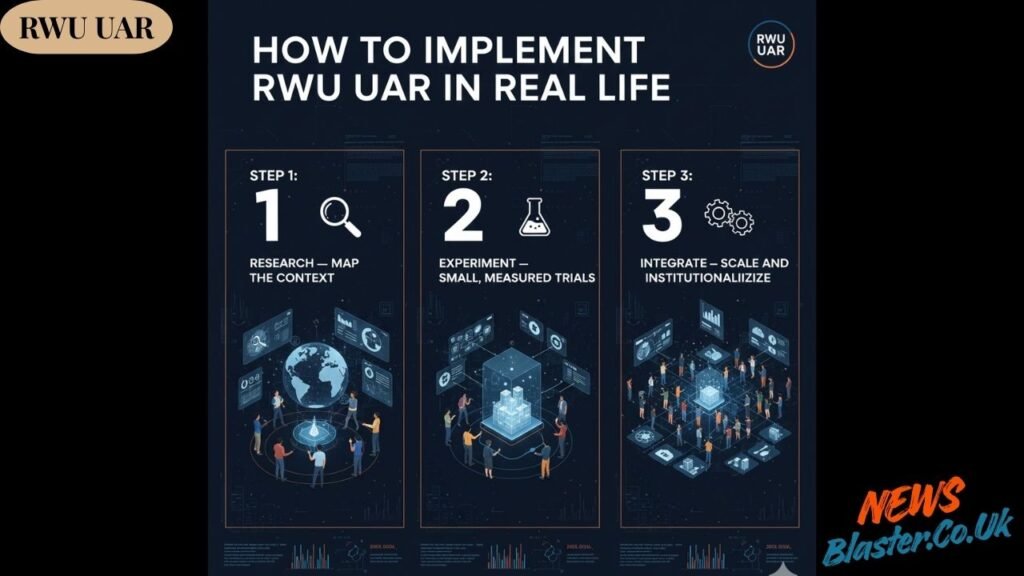
Step 1: Research — Map the Context
Before implementing any RWU UAR initiative, invest time in understanding your specific context. Ask what problem you’re trying to solve or what opportunity you want to pursue. Identify stakeholders and their needs.
In educational settings, this might mean surveying students about research interests or consulting faculty about capacity to mentor. In technical environments, it could involve auditing current access protocols or identifying security gaps.
Document your findings clearly. Good implementation begins with an accurate understanding, not enthusiastic assumptions.
Step 2: Experiment — Small, Measured Trials
Once you understand your context, design small experiments. If launching an undergraduate research program, start with a pilot cohort of five to ten students rather than immediately scaling to hundreds. If redesigning access controls, test new protocols with one department before rolling out system-wide.
Small trials let you identify problems while the stakes remain manageable. They also build credibility and enthusiasm. Early participants become advocates who help refine your approach and persuade others to join.
Monitor your experiments carefully. Collect feedback regularly and be willing to adjust quickly when something isn’t working.
Step 3: Integrate — Scale and Institutionalize
After successful pilots, begin scaling thoughtfully. Develop standard procedures, training materials, and evaluation metrics. Create infrastructure that allows new participants to join without requiring constant intervention from program founders.
Integration also means connecting your RWU UAR initiative to existing structures. Link undergraduate research programs to academic advising systems. Tie access control improvements to broader cybersecurity strategies. Show how your work supports institutional goals rather than existing as an isolated project.
Plan for sustainability from the start. Consider funding sources, leadership succession, and how you’ll maintain quality as you grow. The most successful implementations become so integrated that they’re no longer seen as special initiatives but simply as “the way we do things here.”
Common Misconceptions About RWU UAR
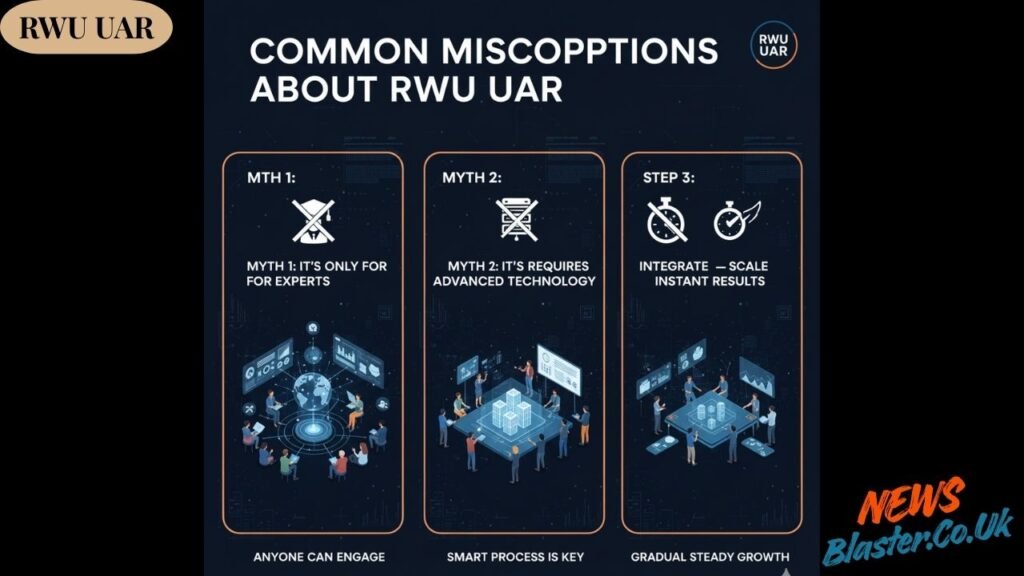
Myth 1: It’s Only for Experts
Many people assume RWU UAR concepts require advanced credentials or specialized training. This misconception prevents capable individuals from engaging with ideas that could benefit their work.
In reality, RWU UAR principles are accessible to anyone willing to think systematically. Undergraduate students complete RWU UAR research projects. Small organizations without dedicated IT departments implement RWU UAR-inspired access protocols. The barrier is not expertise but willingness to learn.
Myth 2: It Requires Advanced Technology
Another common belief is that implementing RWU UAR demands cutting-edge technology or expensive tools. While sophisticated technology can enhance certain applications, it’s not a prerequisite.
Universities run meaningful undergraduate research programs with basic lab equipment and open-source software. Organizations improve access management using standard cloud tools they already have. The critical ingredients are clear thinking and good process design, not technological sophistication.
Myth 3: It Guarantees Instant Results
Some advocates oversell RWU UAR as a magic solution that immediately transforms organizations or projects. This creates unrealistic expectations and sets up initiatives for perceived failure.
Effective implementation takes time. Pilot programs require multiple iterations before they run smoothly. Cultural change happens gradually as people see benefits and build trust. Promising instant transformation is dishonest and counterproductive.
Better to set modest expectations and then exceed them than to promise miracles and disappoint.
Global Interest and Online Curiosity About RWU UAR
Search trends reveal growing global interest in RWU UAR across multiple regions. Educational institutions in North America, Europe, and Asia increasingly reference the concept in program materials and conference presentations.
Online forums dedicated to educational innovation regularly feature discussions about RWU UAR implementation challenges and successes. Technology communities share implementation tips and troubleshooting advice. This cross-pollination of ideas from different fields enriches understanding and generates novel applications.
Social media analytics show that RWU UAR mentions spike around major academic conferences and technology summits. This suggests the concept serves as a conversation starter among professionals looking for fresh approaches to persistent challenges.
The pattern of online curiosity indicates that RWU UAR occupies an interesting niche — specific enough to feel substantial but flexible enough to invite reinterpretation. This balance between definition and openness appears to be precisely what draws continued attention.
The Future of RWU UAR
Looking ahead, RWU UAR seems poised for continued evolution rather than standardization. Rather than settling into a single fixed meaning, the concept will likely maintain its flexibility while gaining depth within specific domains.
In education, expect more sophisticated undergraduate research programs that use RWU UAR branding to attract students and funding. These initiatives will increasingly emphasize career preparation alongside scholarly contribution, recognizing that research skills translate to many professional contexts.
Technology applications will grow more nuanced as cybersecurity and data privacy concerns intensify. Organizations will develop more refined RWU UAR-based frameworks that balance accessibility with protection, drawing on lessons from early implementations.
Interdisciplinary collaboration will remain a strong theme. As complex global challenges demand input from multiple fields, concepts like RWU UAR that facilitate cross-boundary communication will become more valuable. Climate research, public health, and social inequality all require approaches that transcend traditional academic silos.
The most exciting possibility is that RWU UAR thinking — research-led, collaborative, adaptable — becomes so widely adopted that the specific acronym matters less than the mindset it represents.
Conclusion: Why RWU UAR Matters for the Future
RWU UAR matters because it represents a way of working that responds to contemporary needs. Whether applied in universities, technology companies, research consortia, or community organizations, the principles behind RWU UAR — systematic inquiry, inclusive participation, flexible structures — address real challenges.
Students gain opportunities to contribute meaningfully to scholarship rather than passively consuming it. Organizations develop more secure and efficient systems while empowering users. Researchers collaborate across boundaries that once seemed impermeable.
Perhaps most importantly, RWU UAR demonstrates that useful concepts don’t require rigid definition. In a complex world, tools that adapt to context while maintaining core values offer advantages over those that insist on universal, unchanging application.
For readers considering whether to engage with RWU UAR in their own work, the question is not whether the acronym will become universally standardized — it probably won’t. The question is whether research-led, collaborative, adaptable approaches serve your goals. If they do, RWU UAR provides a framework and a conversation starter, which is often exactly what’s needed to begin meaningful change.
Frequently Asked Questions About RWU UAR
What does RWU UAR stand for?
RWU UAR has multiple meanings depending on context. In education, it often means university-based undergraduate research programs. In technology, it can refer to read/write units and user access requests. The acronym is intentionally flexible to serve different fields.
Is RWU UAR only relevant to universities?
No. While universities use RWU UAR to describe research programs, the underlying principles apply to any organization interested in systematic inquiry, collaboration, and adaptive structures.
Do I need special training to implement RWU UAR?
Not necessarily. While expertise helps, the core concepts are accessible to anyone willing to think systematically and learn from experience. Start small and build from there.
How long does it take to see results from RWU UAR implementation?
This varies by context and scale. Small pilots might show results within weeks or months. Institutional culture change typically requires years of consistent effort.
Where can I learn more about RWU UAR?
Look for conference presentations, academic journals in your field, and online communities focused on educational innovation or technology implementation. Many institutions share case studies about their experiences.
Quick Facts & Figures (Where available)
- RWU UAR appears across the education, technology, and research sectors
- The concept emphasizes collaboration, flexibility, and systematic inquiry
- Implementation typically follows a research-experiment-integrate progression
- Online interest has grown steadily over the past decade
- Applications range from undergraduate research programs to IT security protocols
How to Use This Guide (Practical Next Steps)
This guide serves multiple purposes depending on your needs:
If you’re exploring RWU UAR for the first time, start with the definitions section to understand context, then read about applications in your field of interest.
If you’re planning implementation, Focus on the implementation steps section and study the misconceptions to avoid common pitfalls.
If you’re researching RWU UAR academically, review the origins and development section, then examine how different fields interpret and apply the concept.
If you’re looking for specific answers, jump to the FAQ section for quick information, then explore related sections for a deeper understanding.
Whatever your starting point, remember that RWU UAR is less about mastering a fixed concept and more about adopting a mindset — one that values inquiry, embraces collaboration, and remains open to evolution.
Also Read: IT Wordsearch The Ultimate Guide to Tech-Themed Puzzle Fun