

Introduction to Demainmail
In today’s digital landscape, protecting personal information has become more crucial than ever. Demainmail emerges as a practical solution for individuals seeking to maintain their online privacy while navigating various web services and platforms.
At its core, demainmail serves as a temporary email service that allows users to generate disposable email addresses instantly. These addresses can receive messages without requiring users to compromise their primary email accounts or share personal information with potentially untrustworthy sources.
The demand for temporary email solutions continues to grow as internet users become increasingly aware of data privacy concerns. Every time someone signs up for a new service, downloads a resource, or registers for a trial, they risk exposing their primary email address to spam, data breaches, and unwanted marketing campaigns.
Within the email management ecosystem, demainmail occupies a unique position. Rather than serving as a replacement for traditional email services, it acts as a protective buffer between users and the countless websites requesting email verification. This approach helps individuals maintain cleaner inboxes while exploring online services without long-term commitment.
Understanding Temporary Email Services
Temporary email services, also known as disposable or throwaway email addresses, provide users with functioning email addresses that exist for limited periods. These addresses can receive incoming messages just like regular email accounts, but they’re designed to expire after a predetermined time or once their purpose has been fulfilled.
The concept behind disposable email addresses is straightforward yet powerful. Users generate these addresses on demand, use them for specific purposes, and then allow them to disappear without any trace linking back to their permanent contact information.
Common scenarios where temporary emails prove valuable include registering for online forums, accessing gated content that requires email verification, signing up for newsletters to receive one-time discounts, testing new applications during development, and participating in online contests or promotions.
The fundamental difference between temporary and permanent email solutions lies in their intended longevity and purpose. Permanent email addresses serve as long-term communication channels for personal and professional correspondence, account recovery, and building digital identities. Temporary addresses, conversely, fulfill immediate, short-term needs without creating lasting digital footprints.
Key Features of Demainmail
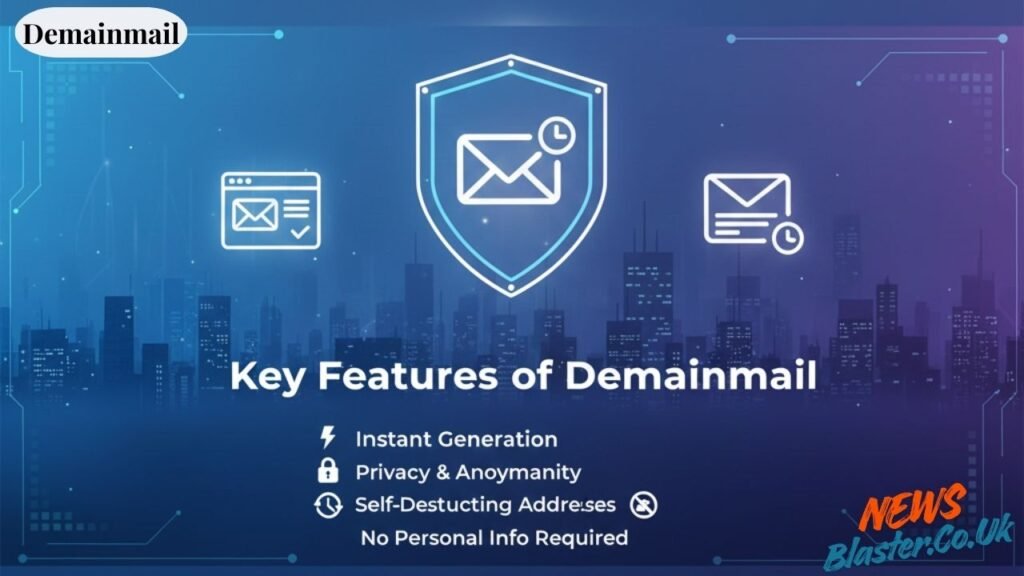
One of demainmail’s most appealing characteristics is its instant email generation capability. Users don’t need to complete lengthy registration forms, create passwords, or verify their identities. The service generates working email addresses immediately upon request, making the entire process seamless and efficient.
The self-destructing nature of email addresses created through demainmail ensures that users don’t accumulate abandoned accounts across the internet. These time-limited addresses automatically expire, eliminating concerns about forgotten credentials or orphaned accounts that could potentially be compromised.
Inbox accessibility remains straightforward with demainmail. Users can view received messages directly through the platform’s interface without downloading additional software or configuring email clients. This web-based approach ensures compatibility across devices and operating systems.
Privacy and anonymity protections form the foundation of demainmail’s value proposition. The service operates without collecting personal information from users, creating a barrier between their real identities and the websites requesting email verification.
Perhaps most importantly, demainmail requires absolutely no personal information to function. Users aren’t asked for names, phone numbers, backup email addresses, or any other identifying details. This zero-information approach maximizes privacy while maintaining full functionality.
How Demainmail Works
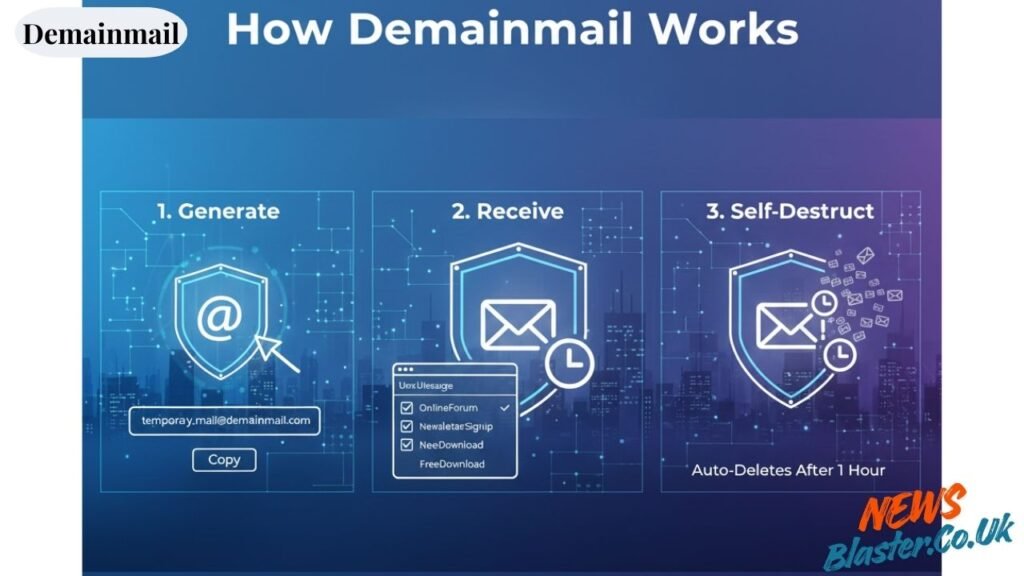
Creating a temporary email through demainmail follows a simple, user-friendly process. Users visit the platform and are immediately presented with a randomly generated email address. Alternatively, they can customize the address prefix to make it more memorable or relevant to its intended use.
Once generated, the email address becomes active and ready to receive messages. Users can copy this address and use it wherever email verification is required. The platform’s interface displays the inbox associated with that temporary address, showing all incoming messages in real-time.
Receiving and reading messages through demainmail requires no special configuration. Emails arrive in the temporary inbox just as they would in any standard email service. Users can view message content, including text and HTML formatting, directly through their web browsers.
The email lifespan varies depending on the service’s configuration. Some temporary addresses remain active for specific durations—ranging from minutes to hours—while others persist until users manually delete them. Automatic deletion mechanisms ensure that expired addresses and their contents are permanently removed from the system.
Behind the scenes, demainmail operates on technical infrastructure designed to handle high volumes of incoming messages while maintaining user privacy. The service uses mail servers configured to accept messages for any address within its domain, routing them to the appropriate temporary inboxes without storing personal user data.
Practical Applications

Free trials and promotional offers represent one of the most common use cases for demainmail. Many services require email verification before granting access to trial periods, but users may not want to receive ongoing marketing communications. Temporary email addresses allow individuals to access these trials without cluttering their primary inboxes.
Software developers and quality assurance professionals frequently use services like demainmail when testing web applications. Testing email verification flows, password reset functionalities, and notification systems requires multiple email addresses, making temporary email services invaluable tools in development workflows.
Avoiding spam and unwanted marketing emails motivates many users to adopt temporary email solutions. By providing disposable addresses to websites with aggressive marketing practices, users can access desired content while maintaining control over what reaches their primary inboxes.
Protecting primary email accounts from data breaches has become increasingly important as high-profile security incidents continue to make headlines. When websites experience breaches, attackers gain access to user email addresses, which they can use for phishing attempts or sell on dark web marketplaces. Using temporary addresses for non-critical registrations minimizes this exposure.
One-time verifications and registrations benefit significantly from temporary email services. Whether downloading a whitepaper, accessing a limited-time resource, or participating in a single-use survey, demainmail provides the verification needed without creating permanent digital relationships.
Privacy and Security Considerations
Data protection measures implemented by demainmail focus on minimizing information collection and retention. The service operates on the principle that the best way to protect user data is to never collect it in the first place. This approach significantly reduces the risk of privacy breaches.
However, users must understand the limitations of temporary email services. These addresses should never be used for important accounts like banking, primary social media profiles, government services, or any platform requiring long-term access. Since temporary addresses expire, users would lose the ability to recover accounts or receive critical notifications.
When comparing security features with competitors, demainmail’s zero-registration model stands out. While some services require users to create accounts before generating temporary addresses, this approach introduces additional privacy concerns. Services that operate without user accounts minimize attack surfaces and data exposure risks.
Understanding the trade-offs between convenience and security helps users make informed decisions. Temporary email services prioritize accessibility and ease of use, which means they typically lack advanced security features like end-to-end encryption or two-factor authentication. These services aren’t designed to replace secure email providers but rather to supplement them for specific use cases.
Advantages of Using Demainmail
Speed and convenience rank among demainmail’s most significant advantages. Users can generate working email addresses in seconds without navigating complex setup processes or waiting for confirmation emails. This immediacy makes the service ideal for situations requiring quick email verification.
The absence of account creation requirements eliminates friction from the user experience. There are no passwords to remember, no security questions to answer, and no personal details to provide. Users simply generate an address, use it, and move on.
Spam prevention for primary inboxes represents a tangible benefit that users notice immediately. By isolating potentially spam-generating registrations in temporary addresses, users keep their main email accounts clean and focused on legitimate correspondence.
Multiple disposable addresses on demand provide flexibility for users managing various online activities. Whether separating different types of registrations or testing multiple scenarios, the ability to generate numerous temporary addresses without limitation proves extremely useful.
Cost-effectiveness makes demainmail accessible to everyone. Most temporary email services, including demainmail, operate as free platforms, removing financial barriers while delivering genuine value to users concerned about privacy and inbox management.
Potential Drawbacks and Limitations
The receive-only functionality of most temporary email services, including demainmail, represents a significant limitation. Users cannot send outgoing messages from these addresses, which restricts their utility to passive email reception scenarios. Situations requiring two-way communication necessitate traditional email services.
The public nature of some temporary email platforms raises security concerns for certain use cases. Since anyone can theoretically access a temporary inbox if they know or guess the address, users should never use these services for receiving sensitive information like password reset links or confidential documents.
Limited email retention periods mean that messages received through temporary addresses won’t be available indefinitely. Users must view and save any important information before the address expires and its contents are deleted. This time-sensitive nature requires careful planning and attention.
Important or sensitive communications should never route through temporary email services. Account recovery emails, financial statements, legal documents, and personal correspondence belong in secure, permanent email accounts with proper authentication and backup mechanisms.
Some websites have begun blocking known temporary email domains to prevent abuse and ensure user accountability. While demainmail and similar services continue adapting to these challenges, users may occasionally encounter platforms that reject temporary email addresses during registration.
Demainmail vs. Competitors
The temporary email market includes several established players, each offering slightly different features and approaches. Guerrilla Mail has built a reputation for its straightforward interface and reliable service delivery. The platform allows users to send outgoing messages, distinguishing it from purely receive-only services.
10 Minute Mail takes a time-based approach, providing addresses that automatically expire after ten minutes unless users extend the duration. This predictable lifespan makes it ideal for quick verifications where users need temporary access but don’t want addresses lingering indefinitely.
Temp Mail offers mobile applications alongside its web interface, catering to users who primarily access services through smartphones and tablets. The mobile-first approach acknowledges the growing trend of on-the-go internet usage.
Demainmail’s unique selling points include its balance of simplicity and functionality. The service provides essential temporary email features without overwhelming users with unnecessary options or complex configurations. This streamlined approach appeals to individuals seeking straightforward solutions.
User experience and interface considerations play crucial roles in distinguishing temporary email services. Demainmail prioritizes clean design, fast loading times, and intuitive navigation. Users can accomplish their goals—generating addresses and checking inboxes—without consulting documentation or tutorials.
Best Practices for Using Temporary Email Services
Knowing when to use temporary emails requires judgment and awareness of context. Appropriate scenarios include accessing free resources, registering for services users want to evaluate before committing, participating in promotions, and any situation where providing a permanent email address seems excessive relative to the value received.
Conversely, users should avoid temporary emails when establishing accounts they intend to use long-term, receiving sensitive information, setting up financial services, creating social media profiles they want to maintain, or any scenario requiring account recovery capabilities.
Managing multiple temporary addresses simultaneously can become confusing without organization. Users might consider keeping notes about which temporary addresses they’ve used for specific purposes, especially when those addresses need to remain active for extended periods.
Keeping track of important verification emails requires vigilance since temporary inboxes clear after expiration. Users should immediately save confirmation codes, download attached documents, or complete required verifications upon receiving messages rather than assuming they can return later.
Combining temporary email services with other privacy tools creates comprehensive protection strategies. Virtual private networks mask IP addresses, password managers generate unique credentials for each service, and browser extensions block tracking cookies. Together with temporary emails, these tools form robust privacy frameworks.
Future of Temporary Email Services
Evolving privacy regulations worldwide will likely impact how temporary email services operate. Legislation like GDPR in Europe and CCPA in California emphasizes user rights regarding personal data, potentially creating more favorable environments for privacy-focused services like demainmail.
Technological advancements in email security may influence temporary email platforms’ capabilities. As encryption standards improve and authentication methods become more sophisticated, temporary email services might incorporate advanced features while maintaining their core simplicity and accessibility.
The role of temporary emails in digital identity management continues to expand as individuals seek greater control over their online presences. Rather than scattering real email addresses across countless websites, users increasingly adopt strategies that separate their true identities from casual online interactions.
Integration between temporary email services and other privacy tools may become more common. Browser extensions that automatically generate and manage temporary addresses, password managers that create coordinated temporary email and credential combinations, and privacy-focused browsers that recommend temporary emails during registrations could all shape the ecosystem’s future.
Conclusion
Demainmail represents a valuable tool in the modern internet user’s privacy toolkit. By providing instant, disposable email addresses without requiring personal information, the service addresses real needs in an increasingly data-hungry online environment.
The platform’s straightforward approach makes email privacy accessible to everyone, regardless of technical expertise. Users can protect their primary inboxes, reduce spam exposure, and explore online services with greater freedom and less risk.
For individuals navigating the internet’s complex landscape, demainmail offers a practical middle ground. It delivers meaningful privacy benefits for everyday scenarios while acknowledging its limitations for sensitive communications. Understanding when and how to use temporary email services empowers users to take control of their digital footprints.
The balance between convenience, privacy, and security defines successful email management strategies. Demainmail contributes to this balance by handling non-critical registrations and temporary verifications, allowing users to reserve their permanent email addresses for communications that truly matter.
As online privacy concerns continue growing, services like demainmail will remain relevant and valuable. By adopting temporary email solutions alongside other privacy practices, users can enjoy the internet’s benefits while minimizing unwanted exposure and maintaining greater control over their personal information.
Also Read: Ziimp .com Tech The All-in-One Digital Platform Revolutionizing Business Operations.